
Most modern robot vacuums can handle small thresholds, but success depends on height, design, and your home’s layout. This guide explains the mechanics, provides step-by-step solutions for common obstacles, and offers tips to ensure your robot navigates transitions smoothly for a truly hands-free clean.
Contents
- 1 Key Takeaways
- 2 Can Robot Vacuums Go Over Thresholds Successfully? Your Complete Guide
- 3 Understanding the Challenge: Why Thresholds Are Tough
- 4 Step 1: Measure Your Thresholds
- 5 Step 2: Know Your Robot Vacuum’s Capabilities
- 6 Step 3: Prepare Your Home and Vacuum
- 7 Step 4: Implement Solutions for Problematic Thresholds
- 8 Troubleshooting Common Threshold Problems
- 9 Conclusion: Achieving a Truly Seamless Clean
- 10 Author
Key Takeaways
- Height is the Primary Limiting Factor: Most robots can clear thresholds of 0.5 to 0.8 inches (13-20mm). Taller transitions often require assistance or a more powerful model.
- Wheel Design and Traction Matter: Large, rubberized wheels and a powerful drive system provide better climbing ability than small, plastic wheels.
- Low-Profile Thresholds are Ideal: Transition strips under 0.5 inches high, like those between vinyl plank flooring, pose little problem for most vacuums.
- You Can Use Ramps as a DIY Solution: For problematic high thresholds, a simple, shallow-angle ramp made of wood or metal can create a bridge for your robot.
- Software and Sensors Play a Crucial Role: Vacuums with advanced mapping and obstacle detection can better approach thresholds at an optimal angle and speed.
- Regular Maintenance Ensures Peak Performance: Keeping wheels clean of hair and debris and ensuring cliff sensors are unobstructed is essential for reliable threshold crossing.
- Know Your Model’s Limits: Always check your vacuum’s specifications for its official “obstacle clearance” height to set realistic expectations.
Can Robot Vacuums Go Over Thresholds Successfully? Your Complete Guide
You want a truly automated clean. You dream of pressing a button and having your robot vacuum handle the entire floor. But then you see it. That strip of metal or wood between your kitchen and living room. That transition from tile to carpet. You wonder, “Can my robot vacuum go over that threshold, or will it get stuck?”
The good news is, yes, many robot vacuums can go over thresholds successfully. But it’s not a simple yes or no answer. Success depends on the height of the threshold, the design of your vacuum, and a few smart tricks you can use.
This guide will walk you through everything. You’ll learn how robot vacuums tackle obstacles. You’ll get clear steps to assess your home’s trouble spots. We’ll show you how to help your vacuum succeed. Let’s dive in and free your robot from its threshold troubles.
Understanding the Challenge: Why Thresholds Are Tough
To a robot vacuum, a threshold is a mini mountain. It must use its wheels to climb up a vertical face, then roll down the other side. Several factors make this hard.
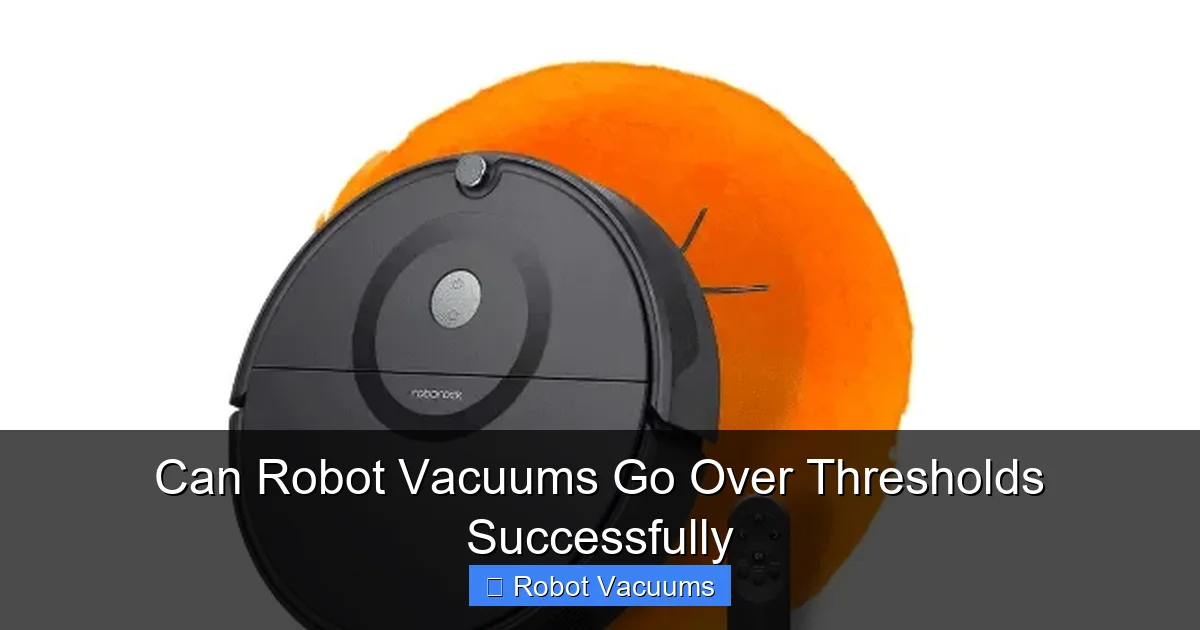
Visual guide about Can Robot Vacuums Go Over Thresholds Successfully
Image source: cdn-bande.nitrocdn.com
First, clearance. The bottom of the vacuum (its chassis) must not scrape or get caught on the top of the threshold. Second, traction. The wheels need enough grip to push the robot up and over. Third, power. The motor driving the wheels needs enough torque for the climb.
Finally, sensors play a role. Cliff sensors on the bottom tell the vacuum there’s a drop. When approaching a threshold, these sensors might see the “cliff” on the other side and stop the vacuum, thinking it will fall. Advanced models use software to understand this is a traversable obstacle.
Step 1: Measure Your Thresholds
Before anything else, grab a ruler or tape measure. This is your most important step.

Visual guide about Can Robot Vacuums Go Over Thresholds Successfully
Image source: robotchores.com
How to Measure Correctly
Measure the height of the threshold from the lower floor surface to its very top. Do this in several spots, as thresholds can be uneven. Note the tallest measurement.
Interpreting the Measurement
- Under 0.5 inches (13mm): This is a low-profile threshold. Most mid-range and all high-end robot vacuums should handle this easily.
- 0.5 to 0.8 inches (13-20mm): This is a common range for door thresholds and transition strips. This is the “maybe zone.” Success depends on your vacuum’s specs.
- Over 0.8 inches (20mm): This is a high threshold. Most standard robots will struggle or fail. You will likely need a specialized model or a helper ramp.
Step 2: Know Your Robot Vacuum’s Capabilities
Not all robots are built the same. Check your manual or product specs online for the key term: “obstacle clearance” or “climbing ability.”
Visual guide about Can Robot Vacuums Go Over Thresholds Successfully
Image source: cdn-bande.nitrocdn.com
Key Features for Threshold Success
- Large, All-Terrain Wheels: Look for big wheels with rubber treads. They provide better grip and roll over obstacles more smoothly than small, hard plastic wheels.
- High-Torque Motor: This gives the wheels the “pushing power” needed to climb.
- Adjustable Suspension: Some premium models can physically raise their body to gain extra clearance when needed.
- Advanced Navigation & Software: Vacuums with LiDAR or vSLAM mapping don’t just bump into thresholds. They approach them strategically, sometimes with a small “run-up” to gain momentum.
As a rule, higher-end models from brands like iRobot (Roomba j7+, s9+), Roborock (S8 Pro Ultra), and Ecovacs (Deebot X2 Omni) are engineered for better obstacle climbing, often up to 0.8 inches or more.
Step 3: Prepare Your Home and Vacuum
A little preparation goes a long way in helping your robot succeed.
Clear the Path
Make sure the area around the threshold is clear of cords, rugs, or debris. Your vacuum needs a clean, straight approach.
Maintain Your Machine
Regularly clean the wheels and their axles. Hair and string can wrap around them, reducing traction and stopping them from spinning freely. Also, wipe the cliff sensors with a dry cloth to keep them functioning correctly.
Start with a Test Run
For a new threshold, supervise the first few cleaning sessions. Watch how your vacuum approaches and attempts the crossing. This will tell you if it needs help.
Step 4: Implement Solutions for Problematic Thresholds
If your vacuum is struggling, don’t give up. Try these proven solutions.
Solution 1: Create a Temporary Ramp
This is the most effective DIY fix. You can buy threshold ramps online or make a simple one.
- Material: Use a thin piece of wood, metal, or even a stiff mat.
- Angle: The ramp must have a very shallow slope. A long, gentle incline is better than a short, steep one.
- Safety: Secure the ramp with double-sided tape to prevent slipping. Ensure it’s stable and flush with the floor on both sides.
Solution 2: Use Virtual Walls or No-Go Zones
If a threshold is simply too high and a ramp isn’t practical, use your app’s features. Set a “No-Go Zone” or “Keep Out Zone” on one side of the threshold. Then, create two separate cleaning schedules—one for each room. You’ll manually place the vacuum in each room, but it will still clean autonomously within them.
Solution 3: The “Carpet Boost” Trick for Transitions to Carpet
Some vacuums have a “Carpet Boost” mode that increases suction and sometimes wheel power when they detect carpet. If your model has this, ensure it’s enabled. The extra power might give it the boost it needs to climb from hard floor onto a thick carpet edge.
Troubleshooting Common Threshold Problems
Is your robot still having issues? Let’s fix it.
Problem: The vacuum approaches the threshold but turns away.
This is likely its cliff sensors being overly cautious. Try cleaning the sensors. Some models allow you to temporarily disable cliff sensors for a cleaning run (check your manual), but do this with extreme caution and only if the threshold leads to another flat surface, not an actual staircase.
Problem: The vacuum gets high-centered and stuck.
Its chassis is caught on the peak of the threshold. This means the threshold is too high for its clearance. Your only solutions are to use a ramp to lower the effective height or to use No-Go Zones as described above.
Problem: The wheels spin but it doesn’t move forward.
This is a traction issue. Clean the wheels thoroughly. If the threshold surface is very smooth (polished metal), consider adding a thin strip of grip tape to the top of the threshold to give the wheels something to bite into.
Conclusion: Achieving a Truly Seamless Clean
So, can robot vacuums go over thresholds successfully? Absolutely. With the right combination of a capable machine, a well-prepared home, and smart solutions, most threshold challenges can be overcome.
Start by knowing your enemy—measure those thresholds. Understand your ally—know your vacuum’s climbing specs. A little maintenance and a simple ramp can often bridge the gap between frustration and flawless automation.
The goal is a clean home without you lifting a finger. By mastering the art of the threshold, you free your robot to do its job everywhere. You move closer to that dream of total, effortless cleaning. Now, go set your robot free!
🎥 Related Video: Roborock Qrevo Curv climbs over door sill / threshold
📺 afterdawncom
Roborock Qrevo Curv can lift its body in order to climb over door thresholds (sills). In this video Qrevo Curv returns back from the …