
Choosing the right bulb for your desk lamp is crucial for comfort, productivity, and eye health. The best modern desk lamps typically use LED bulbs, which offer superior energy efficiency, a long lifespan, and excellent light quality for tasks. Your choice should be guided by three key factors: the bulb’s brightness (measured in lumens), its light color temperature (measured in Kelvins), and the type of base your lamp fixture requires.
Have you ever settled in for a long work session or a good book, only to find the light from your desk lamp is all wrong? Maybe it’s too dim, casting frustrating shadows. Or perhaps it’s a harsh, clinical white that gives you a headache. The problem often isn’t the lamp itself—it’s the bulb. The humble light bulb is the heart of your desk lamp, and choosing the right one transforms your workspace from a chore to a comfort zone.
Gone are the days when you just grabbed a “60-watt bulb” off the shelf. Today, the world of lighting is full of options: LED, CFL, halogen. You see terms like lumens, Kelvins, and color rendering. It can feel overwhelming. But don’t worry! This guide is here to cut through the confusion. We’ll walk you through everything you need to know to choose the perfect bulb for your desk lamp. We’ll talk about the different types, the technical specs that actually matter, and how to match a bulb to your specific task. Let’s shed some light on the subject.
Contents
- 1 Key Takeaways
- 2 📑 Table of Contents
- 3 Understanding Bulb Types: LED, CFL, and Halogen
- 4 Decoding the Specs: What Lumens, Kelvins, and CRI Mean for You
- 5 The Practical Details: Bases, Shapes, and Dimmers
- 6 Matching the Bulb to Your Task
- 7 Common Mistakes to Avoid
- 8 Conclusion: Lighting Your Way to a Better Workspace
- 9 Frequently Asked Questions
- 9.1 Can I use a regular household bulb in my desk lamp?
- 9.2 Why does my new LED bulb flicker in my desk lamp?
- 9.3 Is daylight or soft white better for a desk lamp?
- 9.4 How many watts should a desk lamp bulb be?
- 9.5 What is the difference between an E26 and an A19 bulb?
- 9.6 Can a desk lamp bulb be too bright?
- 10 Author
Key Takeaways
- LED is the Top Choice: For most desk lamps, LED bulbs are the best option due to their energy efficiency, long life, cool operation, and excellent light quality for reading and work.
- Brightness is Lumens, Not Watts: Look for lumens, not watts, to gauge brightness. Aim for 450-800 lumens for a standard desk task light, depending on your needs.
- Color Temperature Affects Mood: Choose a color temperature between 2700K (warm white) and 5000K (cool daylight). For focused work, 4000K-5000K is ideal as it reduces eye strain and boosts alertness.
- Check the Fixture Base: Most desk lamps use a standard E26 (medium) screw base, but some, especially modern or designer models, may use E12 (candelabra) or GU10 pin bases.
- Consider Dimmability: If your lamp has a dimmer switch, ensure you purchase a bulb specifically labeled as “dimmable” to avoid flickering or damage.
- Shape and Size Matter: A classic A19 bulb shape fits most shades, but smaller or directional bulbs (like BR30 or PAR20) can be better for focused light in certain lamp designs.
- Avoid Excessive Heat: Steer clear of old incandescent or high-wattage halogen bulbs in enclosed lamp shades, as they can overheat and become a fire hazard.
📑 Table of Contents
Understanding Bulb Types: LED, CFL, and Halogen
First, let’s break down the main players in the lighting game. Each type has its own pros and cons, especially for use in a desk lamp where you spend hours up close.
LED Bulbs: The Modern Champion
LED (Light Emitting Diode) bulbs are the best all-around choice for desk lamps today. They work by passing an electrical current through a microchip, which illuminates tiny light-emitting diodes. Why are they so good? They are incredibly energy-efficient, using up to 90% less energy than old incandescent bulbs. They last for years—often 15,000 to 25,000 hours. Most importantly for a desk lamp, they emit very little heat. You can work under an LED for hours without feeling a hot spot on your head or hand. They also come in a wide range of brightness levels and colors, from warm, cozy glows to crisp, daylight whites perfect for detail work.
CFL Bulbs: The Fading Contender
CFL (Compact Fluorescent Lamp) bulbs are the curly ones. They work by driving an electric current through a tube containing gas, which produces ultraviolet light that then excites a fluorescent coating to glow. They are more efficient than old incandescents but less so than LEDs. Their biggest drawbacks for desk use are a slight delay when turning on, a less pleasing light quality for some people, and the fact they contain a small amount of mercury, requiring careful disposal. While cheaper upfront than LEDs, their shorter lifespan and inferior light quality make them a less ideal choice for a primary task light.
Halogen Bulbs: The Bright Specialist
Halogen bulbs are a type of incandescent. They produce light by heating a tungsten filament inside a gas-filled capsule. They offer excellent, crisp white light with great color rendering, which is why they’re loved in art studios and for detailed crafts. However, they get extremely hot, are not energy-efficient, and have a relatively short lifespan. Using a high-wattage halogen in a small desk lamp can be a fire risk. They are best used sparingly, in well-ventilated lamps designed for them, and only for specific tasks where their light quality is critical.
Decoding the Specs: What Lumens, Kelvins, and CRI Mean for You
Forget watts. Watts only tell you how much energy a bulb uses. To find the right light, you need to speak the new language of lighting: lumens and Kelvins.
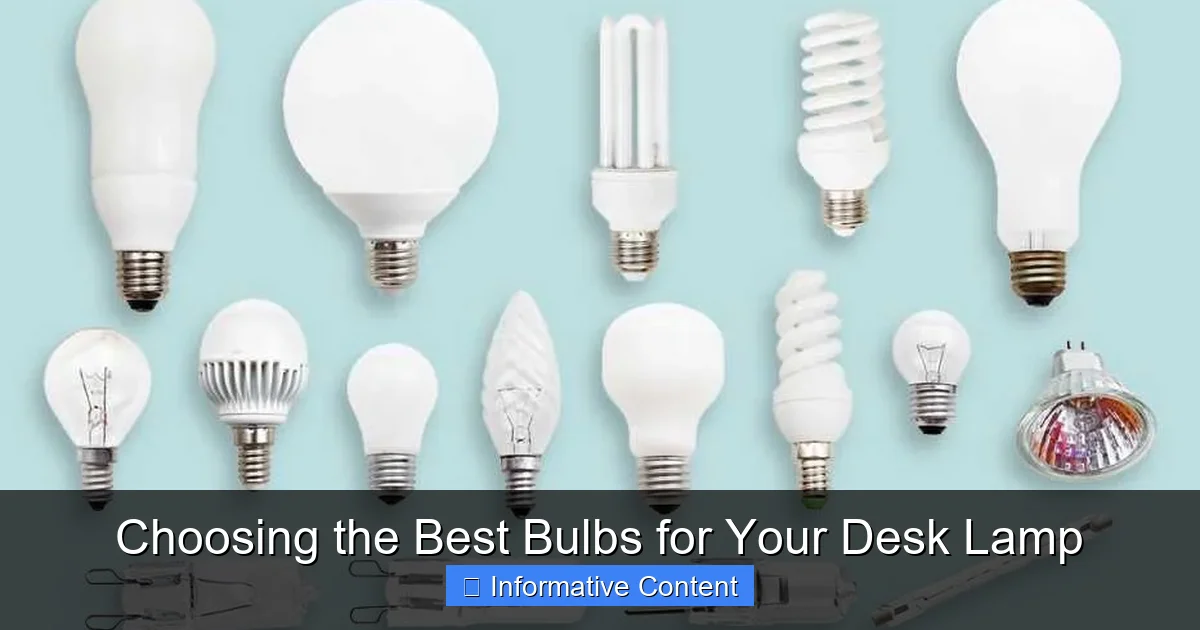
Visual guide about Choosing the Best Bulbs for Your Desk Lamp
Image source: lampity.com
Lumens: The Measure of Brightness
Lumens (lm) measure the total amount of visible light emitted. More lumens means a brighter light. For a standard desk lamp used for reading, writing, or computer work, you generally want between 450 and 800 lumens. Here’s a quick guide:
- 450-600 lumens: Good for ambient or supplemental light, casual reading.
- 600-800 lumens: Ideal for focused task lighting, homework, detailed work, or crafting.
- 800+ lumens: Very bright; best for large desks, drafting tables, or workshops.
If your lamp has a dimmer switch, you can opt for a higher-lumen bulb and dim it down to your preferred level.
Kelvins: The Color of Light
Kelvins (K) measure the color temperature of light, from warm to cool. This is crucial for setting the mood and function of your workspace.
- 2700K – 3000K (Warm White): Yellowish, cozy light similar to old incandescents. Relaxing, but can cause drowsiness. Best for a bedside reading lamp, not a home office.
- 3500K – 4000K (Neutral/Cool White): A clean, white light. This is an excellent middle-ground for a desk, reducing eye strain without being too sterile.
- 5000K – 6500K (Daylight): Bluish-white, simulating noon daylight. This is the best range for maximum alertness, concentration, and color accuracy for tasks like graphic design or detailed crafts. It can feel harsh for nighttime use.
For most desk work, a bulb in the 4000K to 5000K range is the sweet spot.
CRI: The Quality of Color
CRI (Color Rendering Index) is a scale from 0 to 100 that measures how accurately a light source reveals the true colors of objects. Sunlight has a CRI of 100. For a desk lamp where you might be reading, drawing, or sorting materials, a high CRI is important. Look for bulbs with a CRI of 90 or above. This is often found in higher-quality LED bulbs and is a key feature for artists, designers, and anyone who needs to see true colors.
The Practical Details: Bases, Shapes, and Dimmers
Technical specs are useless if the bulb doesn’t physically fit or work with your lamp. Let’s cover the hardware.

Visual guide about Choosing the Best Bulbs for Your Desk Lamp
Image source: flexiblegooseneck.com
Bulb Base Types
The base is the part that screws or pins into the socket. The most common base for desk lamps in North America is the E26 (medium screw base). It’s the standard size. Always check your lamp’s socket or manual. Other possibilities include:
- E12 (Candelabra): A smaller screw base, common in some decorative or vintage-style desk lamps.
- GU10: A two-pin base with a twist-and-lock mechanism, often found in modern, directional task lamps.
- E17 (Intermediate): Less common, but used in some appliances and older lamps.
Bulb Shapes and Sizes
The classic A19 shape (the standard light bulb shape) fits most lamp shades. However, some lamps are designed for more directional light. A BR30 or PAR20 bulb (like a short spotlight) can focus light better in a reflector-style desk lamp, minimizing glare. Always ensure the bulb’s maximum dimensions will fit safely inside your lamp’s shade and housing.
Dimmable Bulbs
If your lamp has a dimmer switch, you must use a bulb labeled “dimmable.” Non-dimmable LEDs or CFLs used on a dimmer will flicker, buzz, or fail prematurely. Not all dimmable bulbs work with all dimmer switches (especially older, leading-edge dimmers), so you may need to experiment to find a compatible pair.
Matching the Bulb to Your Task
Let’s put it all together with some real-world examples.
Visual guide about Choosing the Best Bulbs for Your Desk Lamp
Image source: lamphq.com
- For Home Office/Computer Work: Choose an LED bulb with 500-700 lumens, 4000K color temperature, and a high CRI (90+). This reduces blue light glare from screens and keeps you focused.
- For Reading: Opt for 600-800 lumens. A slightly warmer light (3500K-4000K) can be easier on the eyes for long novels, while 4000K-5000K is better for textbooks or fine print.
- For Crafting or Detailed Hobbies: Prioritize high brightness (800+ lumens) and the highest CRI you can find (95+). A daylight color temperature (5000K-6500K) will help you see details and true colors.
- For a Child’s Homework Desk: Safety first. Use a cool-running LED. Choose 500-700 lumens and 4000K-5000K to promote concentration. Ensure the bulb and lamp are sturdy.
Common Mistakes to Avoid
A quick list of pitfalls can save you time, money, and frustration.
- Ignoring the Maximum Wattage: Your lamp has a maximum wattage rating (e.g., “Max 60W”). With LEDs, this refers to incandescent equivalent wattage. A 10W LED that says “60W Equivalent” is safe to use.
- Using the Wrong Color Temperature: A warm 2700K bulb in a home office will make you feel sleepy. A cold 6500K bulb by your bed will disrupt sleep.
- Overlooking Enclosed Fixtures: If your lamp has an enclosed glass or fabric shade, check the bulb packaging. Some LEDs are not rated for enclosed fixtures and can overheat, shortening their life.
- Choosing Price Over Quality: A cheap, no-name LED bulb may flicker, have poor color rendering, or die early. Investing a few more dollars in a reputable brand pays off in comfort and longevity.
Conclusion: Lighting Your Way to a Better Workspace
Choosing the best bulb for your desk lamp is a small decision with a big impact. It affects your eyes, your energy, and your ability to get things done. By now, you know that LED bulbs are the clear winner for most situations, offering the perfect blend of efficiency, longevity, and light quality. Remember to shop for lumens, not watts, and select a color temperature between 4000K and 5000K for optimal task lighting. Don’t forget to check the base type and dimmability to ensure a perfect fit.
Your desk is a place of creation, learning, and productivity. The right light sets the stage for all of it. So take a moment to look at your current desk lamp. Could it use an upgrade? With your new knowledge, you can confidently pick a bulb that doesn’t just illuminate your desk—it improves your entire experience. Happy lighting!
Frequently Asked Questions
Can I use a regular household bulb in my desk lamp?
Yes, but with a caveat. Most desk lamps use the same E26 screw base as household lamps, so a standard “A19” shaped bulb will fit. However, you should choose a bulb with the appropriate brightness (lumens) and color temperature (Kelvins) for task lighting, rather than just grabbing any bulb from your living room fixture. A task-oriented bulb will be much better for your eyes and focus.
Why does my new LED bulb flicker in my desk lamp?
Flickering in an LED bulb can have a few causes. The most common is using a non-dimmable LED bulb with a dimmer switch. Another cause could be an incompatible or low-quality dimmer switch. Finally, a loose connection in the lamp’s socket or a very cheap, poor-quality LED bulb can also cause flickering. Ensure you’re using a dimmable bulb with a dimmer and check all connections.
Is daylight or soft white better for a desk lamp?
For a desk lamp used for work, reading, or studying, daylight (5000K-6500K) or cool white (4000K-5000K) is generally better. These color temperatures promote alertness and reduce eye strain by providing a crisp, clear light that contrasts well with text and details. Soft white (2700K-3000K) is more relaxing and is better suited for ambient living room or bedroom lighting.
How many watts should a desk lamp bulb be?
Forget watts—think lumens! Wattage only measures energy consumption. For LED bulbs, look for one that provides 450 to 800 lumens for effective desk task lighting. This will typically be equivalent to an old 40-60 watt incandescent bulb but will only use about 6-10 watts of actual power, making it very energy-efficient.
What is the difference between an E26 and an A19 bulb?
E26 and A19 refer to different parts of the bulb. E26 is the base type—the medium screw base that connects to the socket. A19 is the shape and size of the glass globe itself (the classic light bulb shape). A bulb is typically described as an “A19 with an E26 base.” Most standard desk lamps are designed for this combination.
Can a desk lamp bulb be too bright?
Absolutely. A bulb that is too bright for your desk can cause glare on your work surface or computer screen, leading to eye strain, headaches, and discomfort. This is especially true if the bulb is exposed and not properly diffused by a shade. If your light feels harsh, try a bulb with fewer lumens or use a lamp with a dimmer function to adjust it to a comfortable level.