
Choosing the right desk lamp size is about more than just fitting on your desk. It’s about creating balanced, functional lighting that enhances your productivity and comfort. The perfect lamp provides ample light without overwhelming your space, with the shade bottom ideally positioned at eye level when seated to prevent glare.
Have you ever bought a desk lamp that looked perfect online, only to find it’s a giant on your small desk? Or perhaps it’s so tiny it gets lost and doesn’t light up your work at all. Finding the right desk lamp size can be tricky. It’s a puzzle of proportions, function, and personal taste.
This isn’t just about decoration. The right size lamp fights eye strain. It boosts your focus. It makes your workspace a place you want to be. A lamp that’s too big creates glare and shadows. A lamp that’s too small leaves you squinting in the dark.
Let’s solve this puzzle together. We’ll break down the numbers. We’ll talk about your desk and your tasks. By the end, you’ll know exactly how to find a desk lamp that fits your space perfectly. You’ll discover the perfect desk lamp size for your needs.
Contents
- 1 Key Takeaways
- 2 📑 Table of Contents
- 3 Understanding Standard Desk Lamp Dimensions
- 4 How to Choose the Right Size for Your Desk
- 5 The Role of Adjustable Lamps and Arms
- 6 Proportion and Aesthetics: Making It Look Right
- 7 Special Considerations: Beyond the Basic Desk
- 8 Practical Checklist Before You Buy
- 9 Frequently Asked Questions
- 10 Author
Key Takeaways
- Height is Key: For a seated user, the bottom of the lampshade should be at or slightly above eye level, typically between 15 and 25 inches from the desk surface.
- Consider the Base Footprint: The lamp base should be stable and take up no more than 25% of your available desk surface to avoid clutter.
- Shade Size Matters: The shade should be wide enough to distribute light over your work area but not so wide it blocks your view or feels imposing.
- Match Scale to Desk Size: A large executive desk can handle a substantial lamp, while a compact writing desk needs a slimmer, more vertical design.
- Arm Reach is Crucial for Task Lamps: Adjustable arms should be long enough to position the light source directly over your work, not just at the edge of the desk.
- Proportion is Everything: The lamp should look and feel like a natural part of your desk setup, not an afterthought or a dominating centerpiece.
📑 Table of Contents
Understanding Standard Desk Lamp Dimensions
First, let’s talk numbers. What does “big” or “small” actually mean for a desk lamp? Most desk lamps fall within a common range. Knowing this gives you a great starting point.
Overall Height: The Most Important Measurement
The height of a desk lamp is measured from the bottom of the base to the top of the finial (the decorative piece at the very top). For traditional non-adjustable lamps, the magic range is usually between 20 and 30 inches tall.
Why this range? It’s all about eye level. When you are seated, the bottom of the lampshade should be at or just above your eye line. This prevents the bare bulb from shining directly into your eyes. This placement creates a comfortable, glare-free pool of light on your work.
Base Width and Depth: The Foundation
The base needs to be heavy and wide enough to prevent tipping. This is especially true for lamps with long, extended arms. A typical rectangular base might be 6 to 10 inches wide and 4 to 8 inches deep.
Circular bases are common too. Their diameter is usually between 5 and 8 inches. The key is stability. A wobbly lamp is a safety hazard and a nuisance.
Shade Dimensions: Directing the Light
The shade controls where the light goes. Its size directly affects your comfort. A standard desk lamp shade might have a bottom diameter of 8 to 12 inches and a top diameter of 4 to 6 inches.
A wider bottom spreads light over a larger area. A narrower bottom creates a more focused beam. The shade should be deep enough to hide the bulb from your direct line of sight when seated.
How to Choose the Right Size for Your Desk
Now, let’s apply those numbers to your real world. Your desk is unique. Your lamp needs to be its perfect partner.
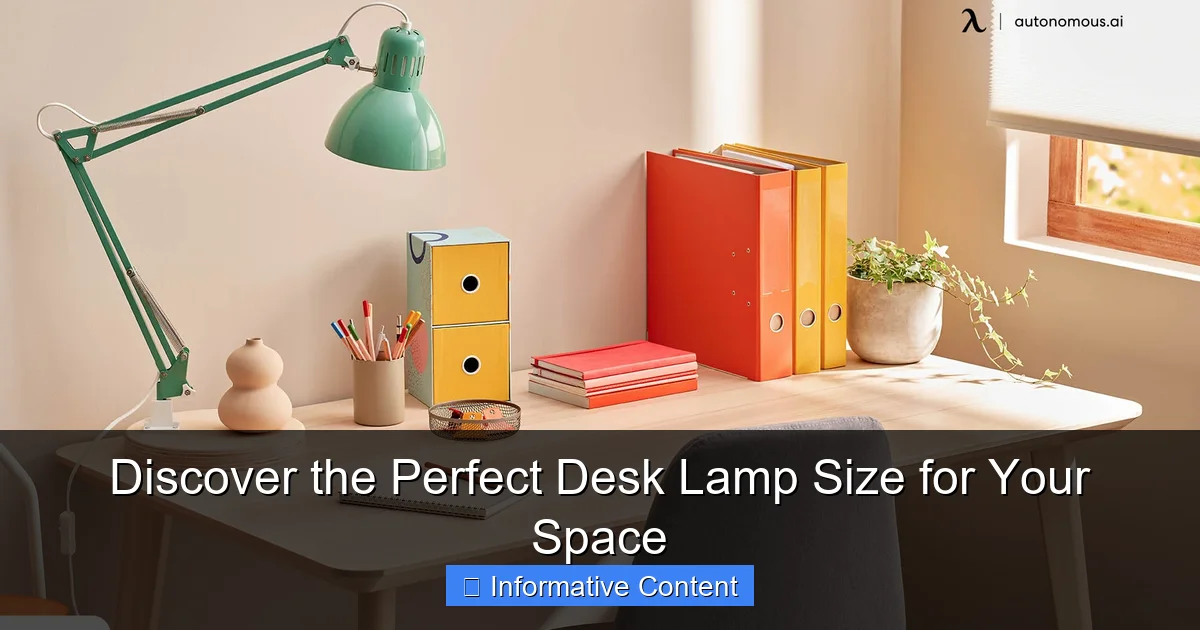
Visual guide about Discover the Perfect Desk Lamp Size for Your Space
Image source: cdn.autonomous.ai
For a Standard Office Desk (60″ x 30″)
This is the classic desk size. It offers plenty of room. You can be more flexible with your lamp choice here. A lamp with a total height of 24-28 inches works beautifully. It will feel substantial but not overwhelming.
You have space for a broader base or a larger shade. This is a great spot for a classic banker’s lamp or a sturdy architect lamp. The lamp can be a statement piece on this size desk.
For a Small or Writing Desk (48″ x 24″ or smaller)
Space is at a premium. Your goal is maximum light with minimum footprint. Look for lamps with a narrower profile.
Consider a lamp that is taller and thinner. Think about a lamp with a small, heavy base. A clip-on lamp can be a genius solution. It attaches to the desk edge or a shelf, taking up zero desk space. For these desks, a lamp height of 18-22 inches is often ideal.
For a Large Executive or Gaming Desk (72″ +)
A massive desk needs a lamp that can hold its own. A tiny lamp will look lost. You might even consider two smaller lamps for different zones.
A larger, more substantial lamp is appropriate here. Heights up to 30 inches or more can work. Look for broader shades to cast light across a wider area. This is also where adjustable floor lamps with long arms can work well, placed behind the desk.
The Role of Adjustable Lamps and Arms
Adjustable lamps change the size game completely. They give you flexibility. A well-designed adjustable lamp can suit almost any desk.

Visual guide about Discover the Perfect Desk Lamp Size for Your Space
Image source: i1.wp.com
Measuring Adjustable Arms
Pay attention to two key specs: reach and flexibility. The arm’s reach is how far the light source can travel from the base. A good task lamp should have an arm that can extend at least 15-20 inches.
This lets you position the light directly over your keyboard, book, or hobby project. The arm should also move up and down easily. Look for strong joints that stay in place once you set them.
Optimal Positioning for Task Lighting
With an adjustable lamp, size is about the final position, not just static measurements. The golden rule: the light should come from over your shoulder.
Position the bulb so it’s in front of you, but the light shines down on your work at an angle. This minimizes shadows cast by your hands. The bulb itself should never be in your direct field of vision.
Proportion and Aesthetics: Making It Look Right
Function is vital. But you also want your lamp to look like it belongs. This is where proportion and style come in.
Visual guide about Discover the Perfect Desk Lamp Size for Your Space
Image source: i0.wp.com
The 1.5 Times Rule (A Simple Guideline)
Here’s a classic interior design trick. For a balanced look, the height of your lamp should be roughly 1.5 times the height of the object next to it.
Is your lamp sitting next to your computer monitor? If the monitor is 18 inches tall, a lamp around 27 inches tall will look harmonious. This isn’t a strict law, but it’s a fantastic starting point for visual balance.
Style Influences Perceived Size
A minimalist lamp with thin metal arms and a small shade feels light and airy. It takes up less “visual space” even if its dimensions are similar to a bulky lamp.
A traditional lamp with a heavy ceramic base and a large fabric shade feels more substantial. It becomes a focal point. Choose a style that matches the visual weight of your other desk accessories.
Special Considerations: Beyond the Basic Desk
Not all “desk” lamps live on traditional desks. Let’s look at some special cases.
Piano Lamps
Piano lamps are long and low. They are designed to span the music sheet stand. Their length is crucial—often 24 to 36 inches long. Their height is very short, usually just high enough to clear the sheet music, often under 12 inches. They provide even, shadow-free light across the entire score.
Bedside Table Lamps
While often used for reading in bed, these follow similar rules. The bottom of the shade should be at shoulder level when you are sitting up in bed. This is typically lower than a desk lamp, around 20-24 inches total height. The base must be very stable on a small nightstand.
Craft and Hobby Lamps
Precision work like sewing, model-building, or drawing needs intense, focused light. These lamps often have very long, articulated arms. They may have magnifying lenses built in. The key is the ability to position a bright, cool light exactly on a tiny detail, often from just a few inches away.
Practical Checklist Before You Buy
Let’s put it all together. Before you click “buy,” run through this simple list.
- Measure Your Desk: Note the width, depth, and how much clear space you have for a base.
- Measure Your Seated Eye Level: Sit at your desk. Have someone measure from the desk surface to your eye line. This is your target for the shade bottom.
- Check the Product Specs: Don’t just look at pictures. Find the detailed dimensions: total height, base dimensions, shade dimensions, and arm reach.
- Think About Your Task: Do you need broad, ambient light for reading, or a focused beam for writing? This affects shade size and bulb brightness.
- Consider Adjustability: If your desk use varies, an adjustable lamp is a safe, versatile bet.
- Visualize It: Use painter’s tape to mark out the base footprint on your desk. Is it too big?
Finding the perfect desk lamp size is a blend of science and art. It’s about measuring your space and understanding your needs. The right lamp doesn’t just illuminate your desk. It transforms it.
Remember the core principle: comfort. The light should help you see, not fight against you. A well-sized lamp becomes a trusted tool. It supports your work, your hobbies, and your well-being every single day.
Take your time. Use the guidelines we’ve discussed. You will find a lamp that fits your desk perfectly. More importantly, you’ll find one that fits your life.
Frequently Asked Questions
What is the average height of a desk lamp?
The average height for a standard, non-adjustable desk lamp is between 20 and 30 inches tall from the base to the top of the shade. The ideal height places the bottom of the lampshade at or slightly above your eye level when you are seated at the desk to prevent glare.
How much space should a lamp take up on a desk?
A good rule of thumb is that the lamp base should not take up more than 25% of your available work surface. For a standard desk, this means a base roughly 6-10 inches wide. The goal is to have ample room for your computer, notebook, and other essentials without feeling cluttered.
Can a desk lamp be too big?
Absolutely. A desk lamp that is too big can create harsh glare if the bulb is at eye level, cast awkward shadows, and dominate the workspace making it feel cramped. It can also physically get in the way of monitors, shelves, or your line of sight.
How do I choose a lamp for a very small desk?
For a small desk, prioritize a slim, vertical design or a clip-on lamp that attaches to the edge. Look for a small but heavy base for stability. A lamp with an adjustable gooseneck or arm is excellent, as you can move the light where needed without moving the base.
What size lamp shade is best for reducing eye strain?
A shade with a bottom diameter of at least 10-12 inches is often best for reducing eye strain. It diffuses light over a wider area, reducing harsh contrasts and bright spots. The shade should be deep enough to completely hide the bulb from your direct view when seated.
Is an adjustable lamp better than a fixed one?
Adjustable lamps offer superior versatility, allowing you to direct light exactly where you need it, which is perfect for task lighting. Fixed lamps are often more stylish and simpler. The best choice depends on your primary use: precise tasks favor adjustable; general ambient lighting can use fixed.