
This guide explains whether “broom” is a noun or verb and how to use it correctly in English sentences. You will learn the main meanings, grammar rules, and common examples. By the end, you will know when to use “a broom” and when you can use “to broom” in clear, natural English.
Contents
- 1 Key Takeaways
- 2 Introduction: Is “broom” a noun or verb?
- 3 Step 1: Understand “broom” as a noun
- 4 Step 2: Learn “broom” as a verb (less common)
- 5 Step 3: Compare noun vs. verb side by side
- 6 Step 4: Use a quick test to decide: Is broom a noun or verb?
- 7 Step 5: Learn common phrases with “broom” (noun use)
- 8 Step 6: When should you avoid “broom” as a verb?
- 9 Troubleshooting: Common mistakes and how to fix them
- 10 Practical tips to remember if “broom” is a noun or verb
- 11 Conclusion: So, is broom a noun or verb?
- 12 Author
Key Takeaways
- Point 1: “Broom” is mainly used as a noun, meaning a tool used for sweeping floors.
- Point 2: “Broom” can be used as a verb, but this is rare and usually informal or regional.
- Point 3: In most situations, you should use the verb “sweep” instead of “broom” when talking about the action.
- Point 4: Grammar rules change depending on whether “broom” is a noun (uses articles) or a verb (uses tense and subject-verb agreement).
- Point 5: Context clues in the sentence help you decide if “broom” is acting as a noun or verb.
- Point 6: Common collocations like “grab a broom” or “new broom sweeps clean” show standard noun usage.
- Point 7: Understanding if “broom” is a noun or verb improves clarity, especially in writing and tests.
Introduction: Is “broom” a noun or verb?
Many learners ask, “Is broom a noun or verb?” This is a useful question. The word “broom” appears in daily life, in school tests, and in English exams. You see it in stories, cleaning instructions, and even in idioms.
In this guide, we will answer the question clearly. We will see when “broom” is a noun and when “broom” can be a verb. You will learn simple grammar rules, step-by-step checks, and many examples. By the end, you will feel confident using “broom” in both spoken and written English.
The main idea is simple: “broom” is usually a noun. It can be a verb, but that use is much less common. Let us go through this carefully so you never have to ask again, “Is broom a noun or verb?”
Step 1: Understand “broom” as a noun
First, we look at the most common use. In everyday English, “broom” is a noun. This is the basic and standard meaning.
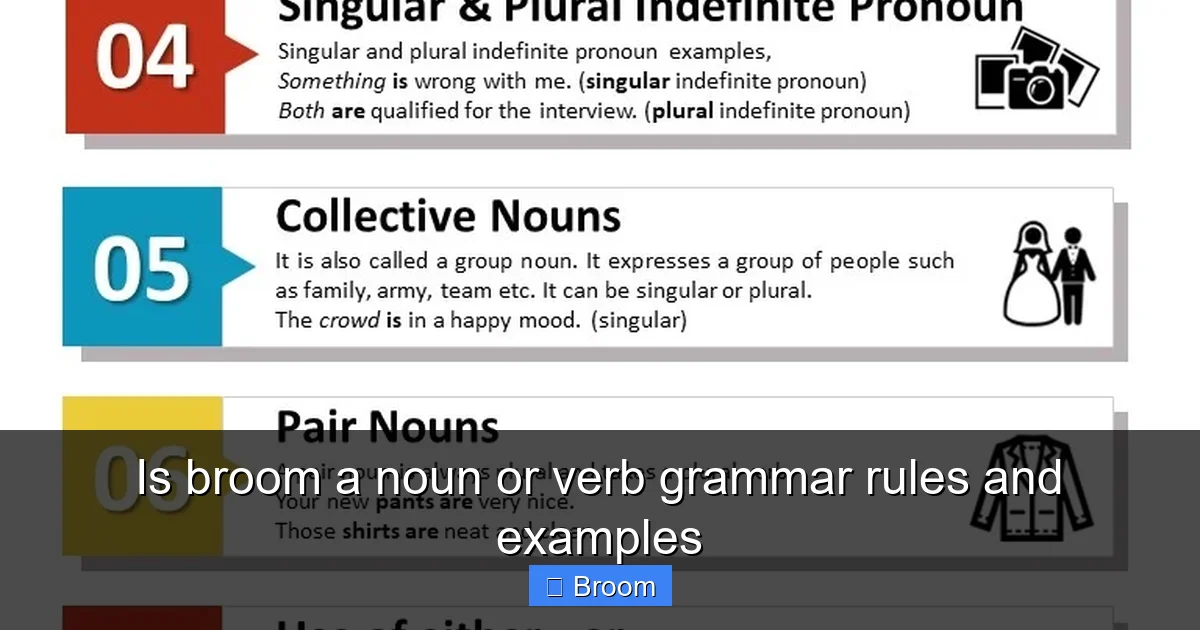
Visual guide about Is broom a noun or verb grammar rules and examples
Image source: englishgrammarsoft.com
What does “broom” mean as a noun?
As a noun, “broom” means a cleaning tool. It has a long handle and bristles at one end. People use a broom to sweep dust, dirt, or crumbs from the floor. This is the meaning you already know from home, school, or work.
Here are some simple examples:
- The broom is in the closet. (noun)
- Please bring me a broom. (noun)
- She bought a new broom for the kitchen. (noun)
- The witch flew on a broom in the story. (noun)
In each sentence, “broom” is a thing. It names an object. That is the key sign that “broom” is a noun.
Grammar signs that “broom” is a noun
To decide “Is broom a noun or verb in this sentence?”, look at the words around it. Nouns follow certain patterns.
Common signs of a noun use:
- It comes after an article: a broom, the broom, this broom, that broom.
- It can be plural: brooms.
- It can be counted: one broom, two brooms.
- It can be owned: my broom, her broom, the school’s broom.
Examples:
- Is broom a noun or verb in this sentence: “I lost my broom”? It is a noun, because it follows the possessive “my”.
- Is broom a noun or verb in “Three brooms were in the corner”? It is a noun, because it is in plural form “brooms”.
Whenever you see “a broom,” “the broom,” or “my broom,” you can be sure “broom” is a noun.
Step 2: Learn “broom” as a verb (less common)
Now we look at the less common use. In some cases, “broom” can be a verb. This is not standard in all kinds of English, but you may hear it in some regions or informal speech.

Visual guide about Is broom a noun or verb grammar rules and examples
Image source: eslgrammar.org
What does “broom” mean as a verb?
As a verb, “broom” means “to clean or sweep with a broom.” It is similar to the verb “sweep.” However, “sweep” is the more correct and usual verb. “Broom” as a verb is often seen as casual, regional, or creative use.
Examples of “broom” as a verb:
- I will broom the porch before guests arrive.
- She broomed the leaves off the steps.
- They broomed the classroom after the party.
In these sentences, “broom” is an action. It tells what someone does. That is how you know it is a verb.
Grammar signs that “broom” is a verb
To answer “Is broom a noun or verb here?”, check if it behaves like a verb in the sentence. Verbs show tense and agree with the subject.
Signs of a verb use:
- It can change form for tense: broom, broomed, brooming.
- It follows a subject: I broom, she broomed, they are brooming.
- It can follow “to” as an infinitive: to broom the floor.
- It can follow helping verbs: will broom, can broom, should broom.
Examples:
- Is broom a noun or verb in “He broomed the hall”? It is a verb, because “-ed” shows past tense.
- Is broom a noun or verb in “They will broom the garage”? It is a verb, because it follows “will” and shows future action.
- Is broom a noun or verb in “She is brooming the balcony”? It is a verb, because “-ing” and “is” show continuous tense.
Remember, even though “broom” can be a verb, most teachers and style guides prefer the verb “sweep.” So in formal writing, it is better to say “I will sweep the floor” instead of “I will broom the floor.”
Step 3: Compare noun vs. verb side by side
To fully understand if broom is a noun or verb in a sentence, it helps to compare them directly. Look at these pairs of sentences:
- Noun: I bought a new broom yesterday.
- Verb: I broomed the kitchen yesterday.
In the first sentence, “broom” is a thing you can buy. In the second, “broomed” is something you did.
- Noun: The broom is behind the door.
- Verb: Please broom behind the door.
In the first, “broom” is the subject of the sentence. In the second, “broom” is the action asked in the command.
- Noun: She keeps her broom in the shed.
- Verb: She brooms the driveway every morning.
Here, “broom” as a noun follows “her.” As a verb, it takes the “-s” ending with “she” in simple present tense.
Step 4: Use a quick test to decide: Is broom a noun or verb?
When you see the word “broom” in a sentence, you can use a simple test. This will help you decide if broom is a noun or verb quickly.
Test 1: Can you add an article or possessive?
Try to put “a,” “the,” “my,” or “her” before the word.
- If it makes sense, “broom” is a noun.
- If it does not make sense, it is probably a verb.
Examples:
- The broom is old. (Makes sense: noun)
- My broom is broken. (Makes sense: noun)
- The broomed is old. (Does not make sense: verb form)
- My brooming is broken. (Does not make sense: verb form)
Test 2: Can you change the tense?
Try to change “broom” to “broomed” or “brooming.”
- If this change makes sense in the sentence, it is a verb.
- If it does not fit, it is a noun.
Examples:
- I broomed the floor. (Makes sense: verb)
- I broom the floor every day. (Makes sense: verb)
- This broomed is new. (Does not make sense: noun position)
Test 3: Ask “Is this a thing or an action?”
Look at the meaning in the sentence.
- If “broom” is a thing you can hold or see, it is a noun.
- If “broom” is something you do, it is a verb.
Examples:
- She leaned on her broom. “Broom” is a thing, so it is a noun.
- She broomed the classroom. “Broomed” is something she did, so it is a verb.
These three tests make it much easier to answer the question “Is broom a noun or verb in this sentence?”
Step 5: Learn common phrases with “broom” (noun use)
Most of the time, you will use “broom” as a noun in fixed phrases and idioms. Knowing these helps you sound natural.
Everyday phrases
- Grab a broom. (Take a broom.)
- Pass me the broom.
- Where is the broom?
- Put the broom back in the corner.
In all of these, “broom” is clearly a noun. You can see the article “the” or “a” before it.
Idioms and expressions
There are also some idioms that use “broom” as a noun:
- A new broom sweeps clean. This means a new leader or manager often makes many changes at first.
- Old broom knows the corners. This can mean an experienced person knows the details very well.
In both idioms, “broom” is a noun that compares a person to a cleaning tool.
Step 6: When should you avoid “broom” as a verb?
Even though we have seen that “broom” can be a verb, you should be careful. In many situations, it is better not to use it as a verb.
Formal writing
In essays, reports, exams, and business emails, it is safer to use the verb “sweep.” Many teachers and exam markers may not accept “broom” as a verb. It can sound too informal or non-standard.
Better choices:
- Correct and standard: I will sweep the floor.
- Less standard: I will broom the floor.
If you want to sound correct in all kinds of English, choose “sweep” as the verb and “broom” as the noun.
International English exams
In tests like IELTS, TOEFL, or school grammar exams, the safe answer to “Is broom a noun or verb?” is usually “broom is a noun.” Examiners expect you to use:
- broom as a noun
- sweep as the verb
So for exam writing, avoid using “broom” as a verb. Keep it simple and standard.
Troubleshooting: Common mistakes and how to fix them
Sometimes learners get confused and mix noun and verb forms. Here are some common mistakes and quick fixes.
Mistake 1: Using “broom” as a verb when the noun is needed
Incorrect: I bought a brooming yesterday.
Problem: “Brooming” is a verb form, but here we need a thing.
Correct: I bought a broom yesterday.
Mistake 2: Using “broom” as a noun when the verb is needed
Incorrect: Please broom the broom.
Problem: This is confusing. It repeats the same word and sounds odd.
Better: Please sweep with the broom.
Or (informal): Please broom the floor with the broom.
Mistake 3: Wrong verb form
Incorrect: She broom the room yesterday.
Problem: Past tense is missing.
Correct (if you choose broom as a verb): She broomed the room yesterday.
Better (standard verb): She swept the room yesterday.
Mistake 4: Confusing readers in writing
If you use “broom” as a verb in writing, some readers may not understand quickly. They may stop and ask themselves, “Is broom a noun or verb here?” This breaks the flow.
To avoid this, use “sweep” as the verb. Then “broom” always stays a clear noun, and your sentence is easy to read.
Practical tips to remember if “broom” is a noun or verb
Here are simple tips you can keep in mind.
- Tip 1: Think of “broom” as a noun first. This is the main and safest meaning.
- Tip 2: Use “sweep” as your normal verb for cleaning floors.
- Tip 3: If you see “a broom,” “the broom,” or “my broom,” it is a noun.
- Tip 4: If you see “broomed” or “brooming,” it is being used as a verb.
- Tip 5: In tests and formal writing, avoid “broom” as a verb to prevent mistakes.
- Tip 6: Ask yourself: “Is broom a thing here, or is it an action?” The answer tells you noun or verb.
Conclusion: So, is broom a noun or verb?
Now you can clearly answer the question: “Is broom a noun or verb?” The word “broom” is mainly a noun. It names a cleaning tool used for sweeping. This is the standard, common, and safest use in all forms of English.
“Broom” can also be used as a verb, meaning “to sweep with a broom,” but this is rare and often informal. In most situations, especially in school or professional writing, you should use the verb “sweep” and keep “broom” as a noun.
When you read or write a sentence, look at the context. Check the words around “broom.” Use the tests in this guide to decide if broom is a noun or verb. With a bit of practice, the difference will feel natural, and you will use “broom” correctly every time.
🎥 Related Video: Singular And Plural | Learn English 📚🤗#shorts #trending
📺 Learn With Ishani
Singular And Plural | Learn English #shorts #trending #trending #short #quotesaboutlife #youtube #trending #viralshorts …